The Aviation Business Models Enabled by RefMap

With the RefMap Project concluding on 30/1/2026, the following post was written by ISCTE - University Institute of Lisbon to provide an overview of their work and results in the project.
Why business models matter in sustainable aviation
Sustainability in aviation is often discussed in terms of technology, cost, or operational efficiency. However, these elements only translate into real-world impact if they are embedded in viable business models. Digital tools that assess climate impacts, noise, air quality, wind, and trajectory optimisation can only influence decision-making if they are aligned with how aviation stakeholders operate, plan, and comply with regulation.
Following up on the work of Future Needs who shaped the RefMap Minimum Viable Product and examined its impact on the aviation ecosystem, ISCTE - University Institute of Lisbon examined how the platform’s integrated environmental tools can give rise to new aviation business model concepts. The analysis focused on identifying structured ways in which environmental intelligence can be delivered as a service, supporting new and existing aviation stakeholders in responding to regulatory, operational, and societal pressures.

From integrated tools to service-oriented concepts
The RefMap platform, developed by ICCS with tools of all technical partners, brings together multiple analytical capabilities that are usually addressed separately: climate impact assessment (UC3M), emissions (KTH) and air quality modelling (S&T), noise exposure (USAL), wind conditions (TUD), and trajectory-related analysis (AFT). The analysis shows that the main value of this approach depends not only on the capabilities of the individual tools, but in their integration within a single analytical digital framework.
By linking these capabilities to stakeholder needs, identified through interviews with experts, ISCTE captured several RefMap-enabled business model concepts. These concepts describe how environmental intelligence could be used in practice. They are not market-ready products, but structured configurations that clarify value propositions, target users, and could be potentially applied in different contexts. A summary of the new value propositions enabled by the RefMap capabilities is shown in Figure 1.

Below, we outline the proposed new business model concepts.
Data-driven environmental analytics services: In this context, RefMap tools are used to provide integrated assessments tailored to specific questions, such as evaluating environmental trade-offs between operational scenarios or supporting sustainability reporting. Potential users include airlines, airports, public authorities, and planners who need consistent and transparent environmental information but currently rely on fragmented data sources. The value proposition aims to reduce complexity and support evidence-based decision-making, particularly in regulatory and planning processes.
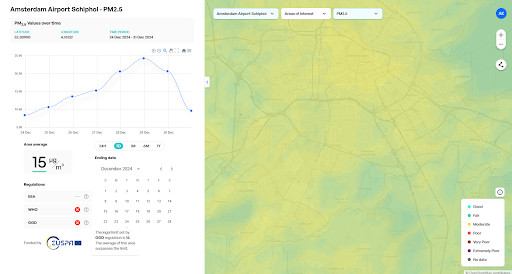
Digital twin services for airports: Airports face increasing pressure related to noise, air quality, climate impacts, and community acceptance. By integrating noise, air quality, wind, and climate indicators into digital representations of airport environments, these services can support infrastructure planning, permitting processes, licence renewals, and communication with regulators and local communities. The emphasis is set on risk mitigation, planning robustness, and transparency, rather than revenue generation.
Planning services for Urban Air Mobility and vertiports: The emergence of Urban Air Mobility introduces new uncertainties for cities, infrastructure developers, and operators. Through planning services, wind modelling, noise assessment, and environmental impact analysis support feasibility studies, site selection, and early-stage planning. These services are particularly relevant where regulatory frameworks are still evolving, and where evidence-based assessments are required to inform decisions and public dialogue.
Green certification and audit support: Environmental certification schemes and sustainability reporting are becoming increasingly important across aviation. RefMap-enabled green certification and audit support services aim to assist stakeholders (regulators, auditors) in preparing environmental evidence aligned with regulatory and voluntary frameworks through standardised and transparent calculations of emissions and environmental impacts.
Environmental risk and impact assessment services: Using RefMap tools, these services help stakeholders identify and assess potential environmental risks, such as noise exposure in sensitive areas, air quality exceedances, or climate-related operational constraints. Such services are relevant for airports operators, and public authorities seeking to anticipate challenges and inform strategic decisions. The value lies in improving awareness and supporting proactive planning.
Trajectory and fleet transition support: These services, enabled through trajectory-related analysis, address strategic and network-level questions where environmental considerations increasingly interact with operational efficiency. The analysis recognises that institutional and regulatory constraints currently limit short-term uptake, particularly for ANSP-related applications. As a result, these concepts are framed as enabling and longer-term, closely linked to policy development and coordinated implementation.
Health impact analytics: By linking environmental outputs such as noise and air quality to population exposure, these services support broader assessments of aviation’s societal impacts, particularly in urban contexts. This approach is relevant for public authorities and planners seeking to integrate aviation considerations into wider health and sustainability strategies.
Key takeaways
New aviation business models can emerge from the systematic integration of environmental intelligence into decision-making processes. Rather than disrupting existing roles, the identified concepts complement current stakeholder activities and respond to regulatory and planning needs identified by stakeholders.
Across all cases, the developed business model concepts provide integrated, multi-domain analytical capability, which supports cross-impact assessment and informed decision-making in a complex and evolving aviation landscape. These business model concepts provide a structured foundation for future exploitation, while recognising that uptake depends on policy alignment, institutional readiness, and stakeholder engagement.